I never went to business school, but I enjoy listening to venture capitalists speak—especially in how they put their money where their mouth and eyes are, placing bold bets not just on present trends, but on future visions of how the world might evolve. One of the key tools they use to articulate and justify these visions is a simple, powerful phrase: Total Addressable Market, or TAM.
This term often comes up when they’re sizing up an opportunity, estimating how big a business could become if it were wildly successful. But more than just a number, TAM is a lens—a way of quantifying the future before it actually arrives. It’s not just about how many customers are out there now, but how many could exist if the product gains traction, shifts behaviors, or creates new demand. As someone trying to understand how great ideas turn into valuable businesses, I’ve been taking time to read up on TAM and how it shapes investment decisions.
Here’s what I’ve gathered so far:
TAM isn’t just a number—it’s a story of scale and possibility.
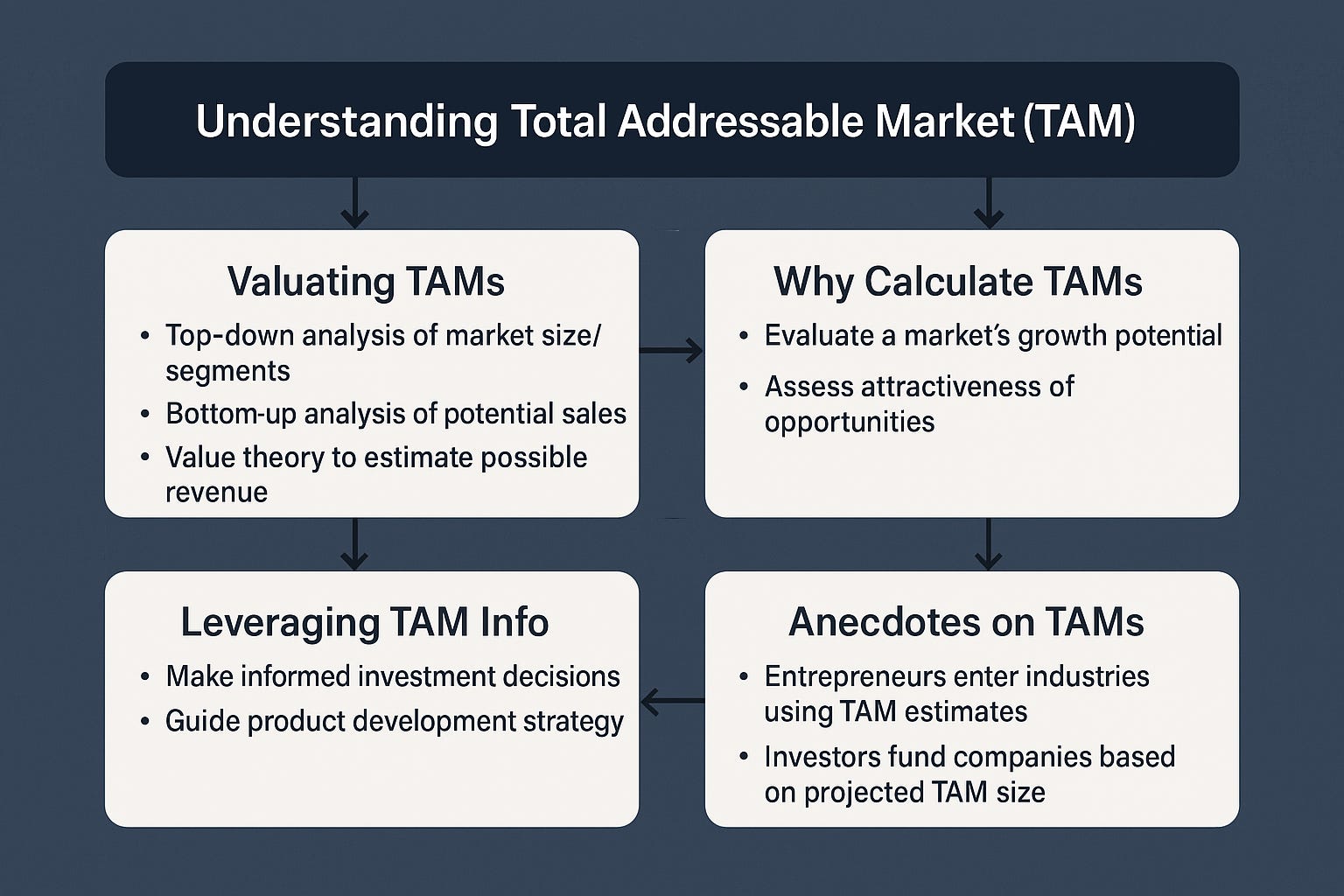
At its core, TAM (Total Addressable Market) is the total revenue opportunity available if a product or service achieved 100% market penetration. It’s a way of asking: If everyone who might need this product actually used it, how much money would that be worth?
Behind every confident pitch is a map of markets and a scribbled TAM trying to foresee the future.
There are a few ways to calculate this:
Top-Down Approach – Start with big, external numbers (like industry reports or macroeconomic data) and narrow it down to your specific segment. This approach is fast and common in pitch decks, but it can easily over- or understate reality if the filters are too broad or too narrow.
Bottom-Up Approach – This builds from actual data, like how many units you sell in one city or how much one customer is worth, and extrapolates that to a larger population. It’s more grounded but requires strong assumptions about representativeness.
Value-Theory Approach – This one is especially interesting. It asks: What is the value of the problem you’re solving, and how much would people be willing to pay to make it go away? It’s a method for emerging or disruptive markets, where past data won’t tell you much, but the perceived value of your innovation might be huge.
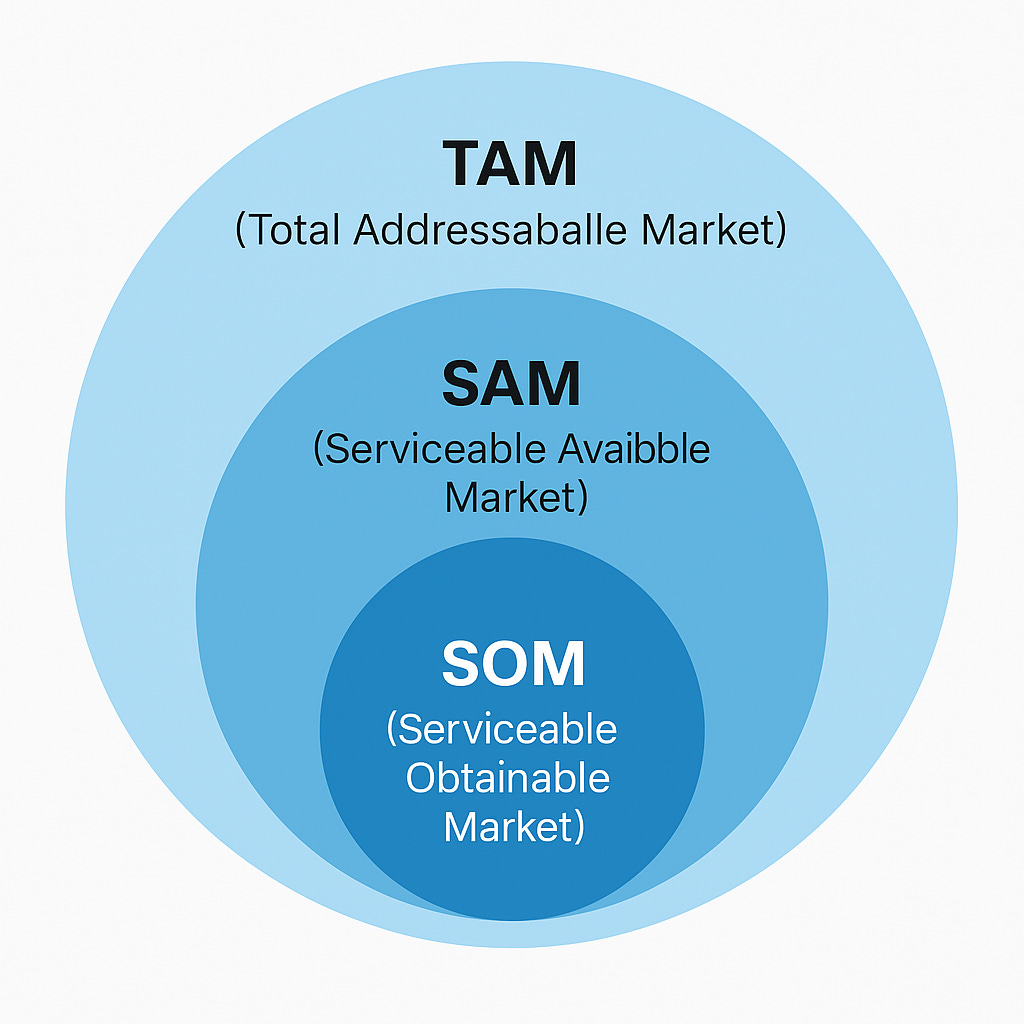
And here’s the nuance: while TAM shows the big picture, investors and operators also look at SAM (Serviceable Available Market—how much of that TAM you can realistically target based on your product/service today) and SOM (Serviceable Obtainable Market—how much of SAM you can likely capture in the short-to-medium term, given competitors and execution constraints).
Not all markets are created equal—TAM is the dream, SAM is the terrain, and SOM is the ground you can actually walk on.
Why is TAM so valuable?
Because it anchors decisions in scale. It’s the difference between chasing a lifestyle business and pursuing a venture-scale business. TAM helps founders:
Judge whether an idea is worth pursuing
Determine what features to build and markets to enter
Prioritize where to allocate time, capital, and talent
And for investors, TAM is often the first test of a business’s potential. If the TAM isn’t big enough, even the best team might not be able to deliver the outsized returns required to justify early-stage risk.
It also shapes how future bets are made. For instance, a founder might decide to focus on one segment first (a “beachhead”) and expand later, knowing the TAM gives them room to grow. This strategy works when the TAM is broad enough to allow adjacent expansion—think of Amazon starting with books but having a clear path to retail, cloud, and beyond.
Now, let’s consider AI—why all the buzz and billions?
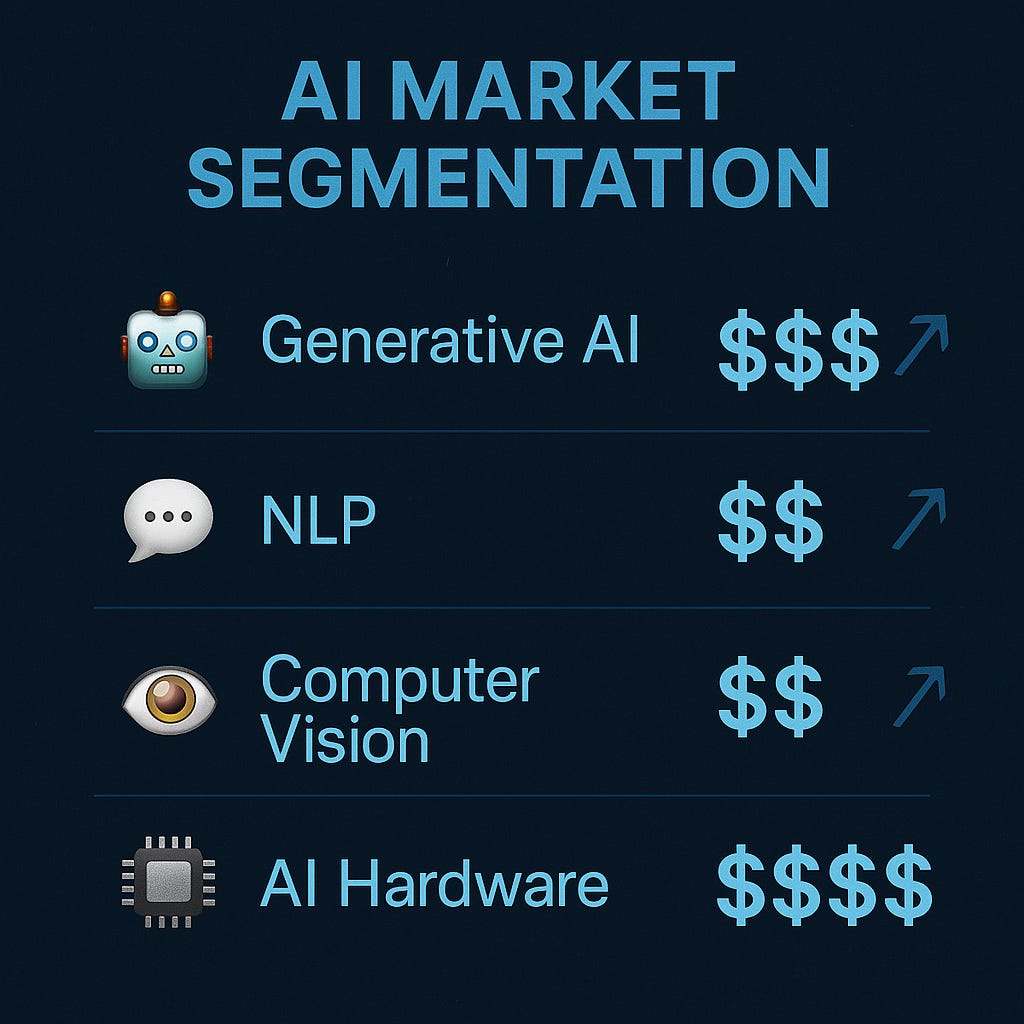
TAM is one of the reasons people are throwing billions into Artificial Intelligence. While the actual market for AI products today might be in the $200–300 billion range, the projected TAM is in the trillions. That includes everything from generative AI to computer vision, natural language processing, AI hardware, and industry-specific applications like AI in healthcare or finance.
The AI market isn’t one monolith—it’s a constellation of rapidly expanding frontiers.
What makes AI unique is that it’s a horizontal platform—a general-purpose technology like electricity or the internet. So its TAM isn’t just “how much people will pay for AI software,” but how much AI will transform existing industries. McKinsey estimates that AI could unlock trillions of dollars in productivity gains across sectors, essentially redefining the TAM of entire markets.
The key point here is that TAM isn't a static number—it's a moving frontier. As behavior changes and technologies mature, the TAM expands, pulling in new users, new use cases, and new capital.
Anecdotes that bring TAM to life
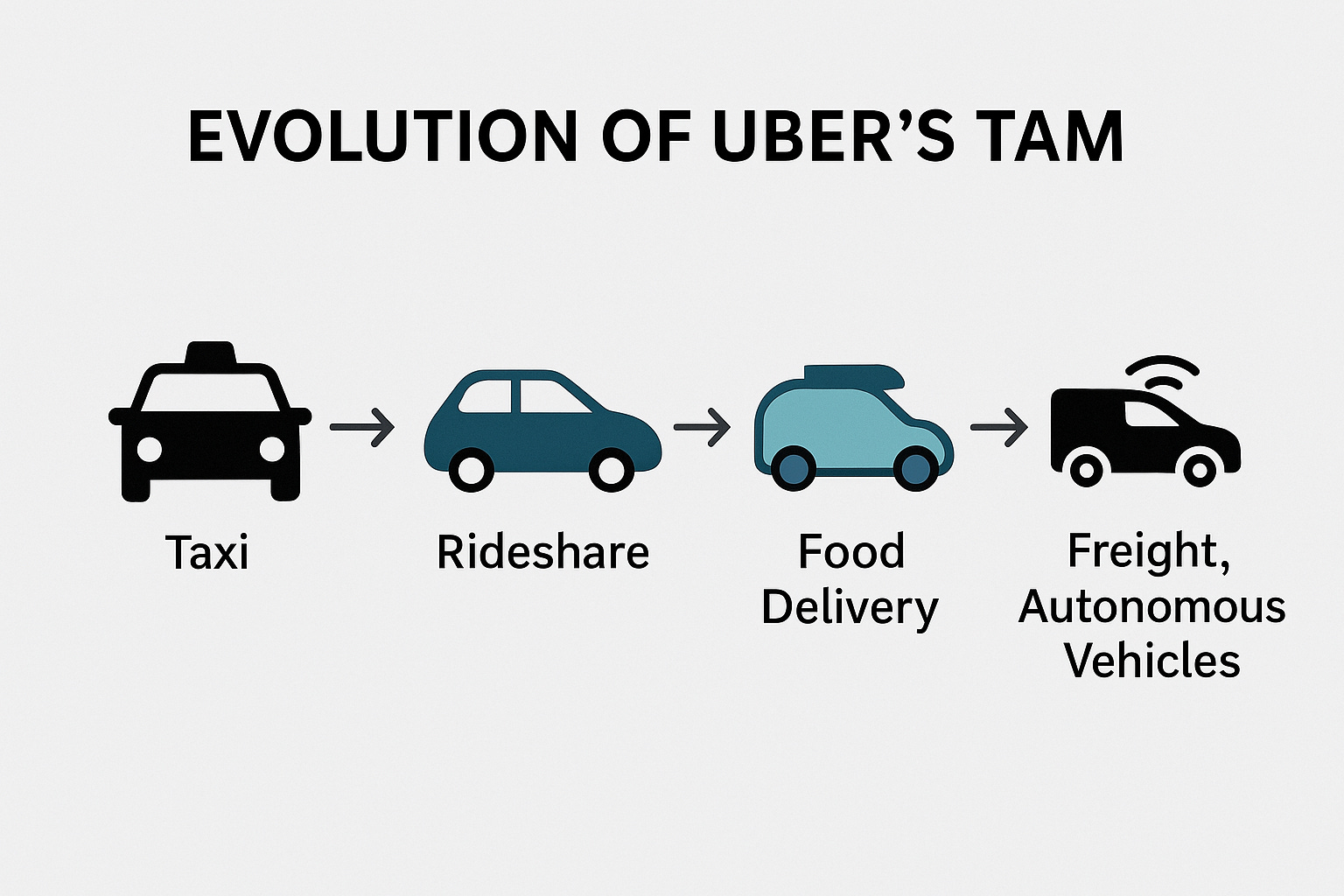
Uber famously redefined its TAM. Critics once said it could only serve the taxi market, but investors like Bill Gurley argued Uber was actually targeting all local transportation—a TAM hundreds of times bigger.
Uber didn’t just take over taxis—it redrew the map of urban mobility.
Spotify looked at the shrinking market of CD sales and downloads, then asked: What if we changed the model to streaming and subscriptions? They didn’t just compete—they reframed the TAM.
WeWork pitched itself not as a real estate firm, but as a platform for the future of work—sizing its TAM in the trillions, not just the square feet of office space.
These aren’t just stories—they’re strategic shifts in how people define the market they’re entering.
Conclusion: TAM as a Map to the Future
TAM is more than a metric—it's a way to perceive probable quantitative futures. It's a tool to reason through not just what exists today, but what could exist tomorrow. When used thoughtfully, TAM helps you imagine future behaviors, product demand, and value creation in numbers—making abstract visions tangible and testable.
In a world of uncertainty, TAM provides a compass. It reminds you to ask: If this works, how big could it be? And if that answer is large enough, and your plan to get there is credible enough, then maybe—just maybe—you’ve found something worth betting on.